
Building smitebot: A Summer of Fuzzing Lightning
I’m Ashish Kumar Dash, a CSE undergraduate at IIT Bhilai, and for Summer of Bitcoin 2026 I worked on smitebot , a campaign manager for Smite, a fuzzing framework for Lightning Network implementations. This is my final report with my work, thoughts and my overall experience.


When Summer of Bitcoin started, I had a fuzzing framework in front of me and a problem nobody wanted to say out loud: running it was an annoying task. Smite fuzzes Lightning Network implementations - LND, CLN, LDK, Eclair, with AFL++ under Nyx. The fuzzing itself was solid. Everything around it was eleven manual steps, each a place to quietly get something wrong. Build the right image. Prep the Nyx sharedir. Launch the runners. Babysit them. Scrape the stats. Tear it all down without leaving virtual machines orphaned in the background.
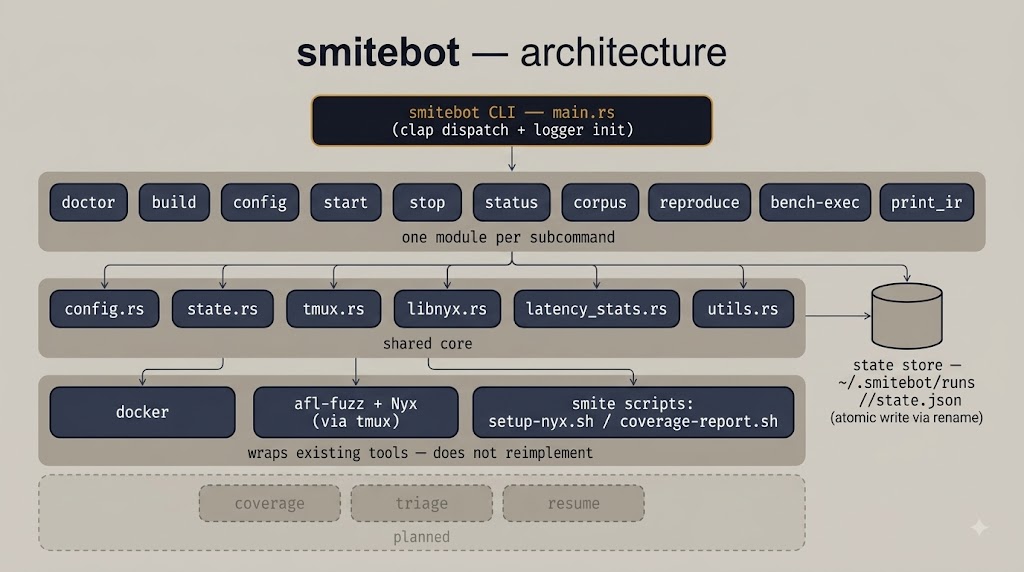
My job for the summer was to make that go away. We called it smitebot - a campaign manager CLI that turns the whole ritual into a handful of commands. One principle from the first day: orchestrate, don’t reimplement. Smitebot wraps the scripts and tools that already exist - Docker, the afl-* binaries, the Nyx setup scripts - it doesn’t try to be smarter than them.
The payoff is that an eight-core LND campaign that used to be eleven careful steps becomes one line:
1
smitebot start campaign.toml
Behind that single command, smitebot builds the Docker image, provisions the Nyx shared directory, spawns the runners, verifies each one is actually alive, and writes a small state file it can find again later. That state file is the spine of the whole tool: stop, status, and reproduce all read the same ~/.smitebot/runs/<campaign-id>/state.json, written atomically (temp file + rename(2)) so a crash mid-write can never leave a half-parsed campaign behind.
The first PR humbled me
I opened my very first pull request with a beautiful skeleton - ten commands, all stubbed out, the whole surface sketched in one go. It got closed. Correctly. You can’t design the tenth command before you’ve built the first one; dead structs are just guesses wearing confidence.
So I started over, one command per PR, and the first real one was doctor - the preflight check that tells you whether your machine can even fuzz. It should have been the easy one. Instead it became the longest review of my summer: seventeen files, round after round of comments, every error message and helper picked apart. There were evenings I closed the laptop genuinely unsure I was cut out for this. But that PR taught me more than any other - how this codebase breathes, what my reviewers actually cared about, and that “it works on my machine” is the beginning of the conversation, not the end. When it finally merged, it didn’t feel like a checkbox. It felt like I’d earned my seat.
What I built
After doctor, the rest came in a steady rhythm, each command its own small argument for existing:
build— workload Docker images from a target and scenario, tagged the way the rest of Smite already expects to find them.config— a validated TOML schema (target, scenario, tool paths, runner count, seeds) that every other command speaks, so validation lives in one place instead of scattered across commands.start— the heart of it: build, provision the Nyx sharedir, and launch N parallel AFL++ runners in Nyx’s parallel mode.stop/status— a teardown that reaps the whole process tree, and a live dashboard parsed straight from each runner’sfuzzer_stats.corpus merge/minimize— collect unique inputs across every runner’s queue (deduped by content, not filename) and prune the redundant ones withafl-cmin.reproduce— replay a single input against a target in a one-shot Docker run (in review as I write this).
The decisions I’m proud of
A few problems forced me to actually understand the system instead of gluing over it.
My first start orphaned runners into the background where you couldn’t see them. It worked, and it was useless - a fuzzer you can’t watch is a fuzzer you don’t trust. Rebuilding it around one tmux window per runner meant every AFL++ screen stayed live and attachable, and a dead runner’s last words stayed on screen instead of vanishing. Getting parallel fuzzing to actually work under Nyx meant learning its quirks the hard way: AFL++’s Nyx parallel mode wants the -Y flag (not the standalone -X), and it insists on numeric runner names — -M 0 for the primary, -S 1, -S 2… for the secondaries.
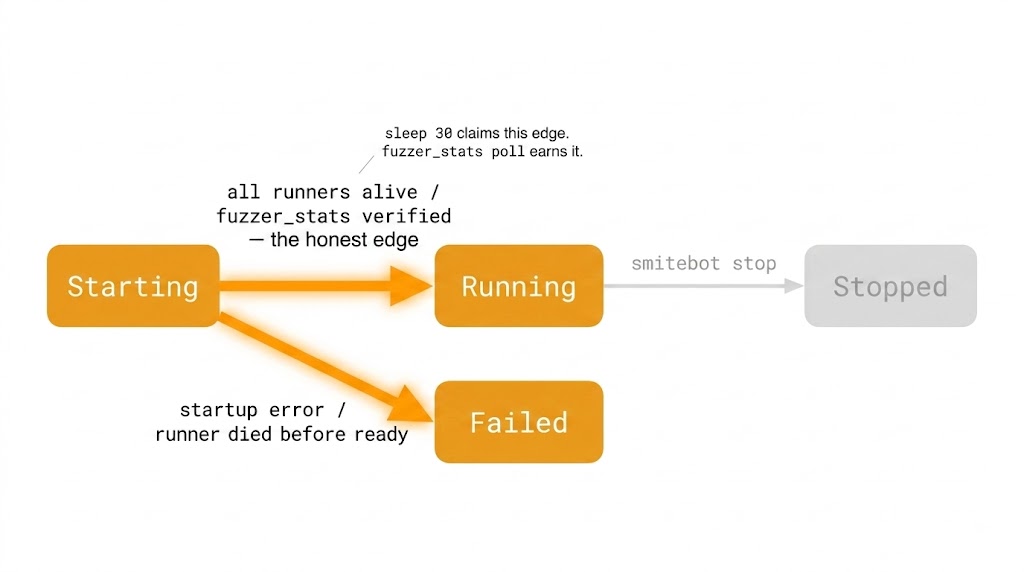
The subtler lesson was what “running” even means. A campaign isn’t up when the process spawns - it’s up when each runner writes its first fuzzer_stats, and under Nyx that can take minutes, because AFL++ restores a full VM snapshot on every single execution while it calibrates the seed corpus. My early code used a fixed timeout and cheerfully reported healthy campaigns as failed the moment a large corpus calibrated slowly. The honest fix was to stop timing the outcome and start reading process state: a fresh fuzzer_stats means started, a dead tmux window means failed, neither-yet means keep waiting. Reporting a live fuzzer as dead isn’t a cosmetic bug - it’s how you end up with orphaned VMs quietly burning a core each.
Running N identical fuzzers wastes those cores too, so smitebot spreads AFL++’s power schedules and mutation flags across the runners for diversity - but deterministically, by hashing each runner’s index, so a campaign stays perfectly reproducible and needs no random-number dependency at all.
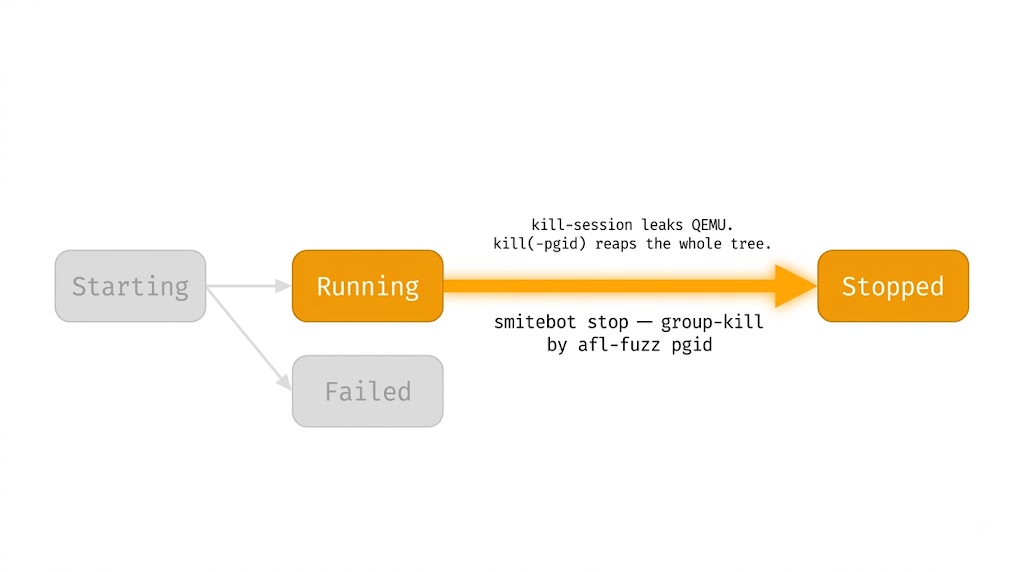
Then there was the leak that taught me to read process trees. Under Nyx each runner drives a QEMU child, and killing the tmux session left those QEMUs alive, reparented and forgotten. The fix wasn’t a bigger hammer — it was noticing that each runner is its own process-group leader and its QEMU rides along in that same group, keeping the group id even after it orphans. So one group-directed kill reaps the whole tree — a SIGTERM, then a SIGKILL for the QEMU processes that, in testing, ignored the polite one.
And everywhere I could, I refused dependencies I could hand-write: a six-line FNV-1a hash (the one driving that strategy distribution) instead of pulling in a crate, the standard library instead of a convenience wrapper, shell-quoting by hand. This is a tool that runs untrusted inputs through VMs on someone’s machine - less code is less to own, and less to own is less to get wrong at 3am.
What shipped, and what’s left
Shipped and merged: doctor, build, config, start, stop, status, and the corpus commands. reproduce is open and waiting on review. Still ahead: Nyx-mode reproduction, scenario validation, then list, resume, crash triage, and
coverage. The scaffolding is done. What remains is the science.
What I actually learned
- Ship one honest command, not ten hopeful ones. Scope is a kindness - to reviewers, and to yourself.
- Disagree with a source, not a feeling. Most of my pushback was settled by pointing at a line of code and the times I was wrong, I learned the most.
- Slow down before irreversible git. I closed a PR once by doing something careless with a branch. Once was enough.
A note about my Mentors
None of this happened alone. My mentors, Matt Morehouse and Nishant Bansal gave me the kind of exacting, patient review that quietly rebuilds how you think. A lot of what I’m proud of in this project is really their standards, absorbed. And it wasn’t only about smitebot. Some of our best conversations wandered past the code - into how AI is reshaping the way open source gets built, who it lowers the barrier for, and who it quietly leaves behind. Those talks stuck with me, because they landed on more than my project. I’m secretary of OpenLake, IIT Bhilai’s open-source society, where a big part of my job is helping juniors take their first real steps into contributing. The direction I picked up in these chats, how to stay valuable in an AI-shifted open-source world, is direction I now carry straight back to them. Mentorship, it turns out, compounds: what Matt and Nishant gave me doesn’t stop with me. I’m grateful and proud to have had the opportunity to work under their mentorship, and looking forward to working together for the foreseeable future.
What happens next
Summer of Bitcoin is ending, but for me smitebot isn’t. I’m staying on smite — I want to take this past a tidy CLI and into the deep end: a daemon that runs campaigns on its own, triages what it finds, and helps surface real Lightning vulnerabilities responsibly. I’m planning to apply for a fellowship to protect real time for that work alongside university, and Matt has agreed to keep mentoring me through it.
The dream I keep coming back to is a differential oracle - feed the same wire message to LND, CLN, LDK, and Eclair at once and flag where they disagree, because that’s exactly where the interesting, spec-level bugs hide that single-target fuzzing will never see.
I came into this summer knowing how to write code. I’m leaving it understanding, for the first time, what it means to build something people will actually depend on. That’s the part I’m keeping.
— Ashish Kumar Dash